Aug 272025

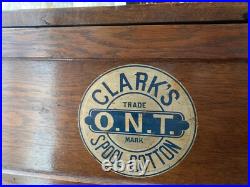

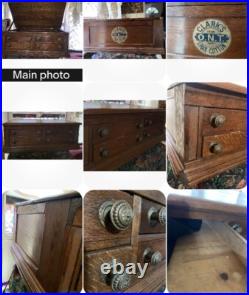



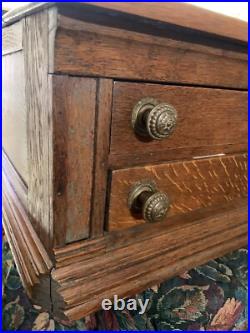
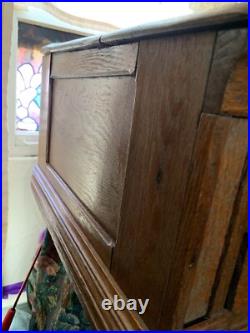


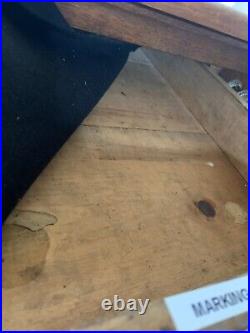
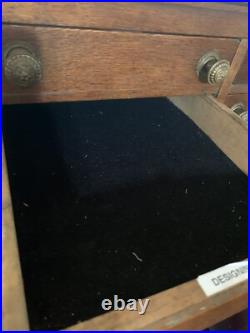
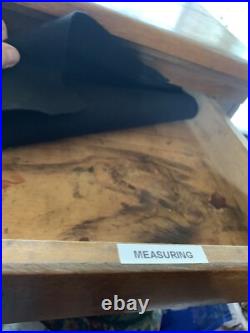
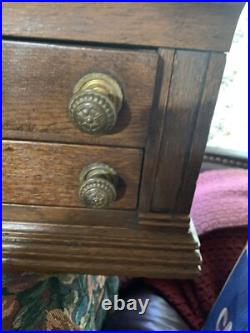







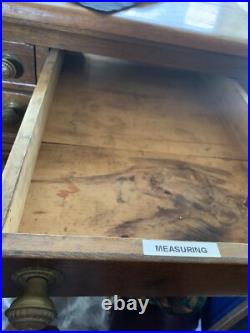


Solid oak in very good antique condition. Four drawers with brass pulls knobs, all present and intact. Top raises and locks in up position with attached wooden rod for support. Depth of inside top slants from about 1″ in front to just over 2″ in back. Presumably this was for housing spools of thread. Could be used like a desk. It measures approximately 29 across at the top of lid, the widest point. The width along sides is about 21.5 at widest point which is the base. Its depth slopes from a little over 12″ in back to a little over 10″ in front. Overall condition is great for its age. Some things to note, not detrimental but worth pointing out, is some scarring to bottom edge in back, couple of knobs loose, but not wobbly. Natural wear to sides where top has been lifted many times over many years, this is smooth and nice and gives authenticity and character as to the age of the piece. Front corner tips of base look as if cut to fit the original counter. They’re finished like that so were most likely made like that to fit counter. I photographed each of these things I just noted. I’m guessing about 35-40 pounds. Spool Cotton logo decal and it is in terrific shape; no peeling or scarring. This side would have faced out toward the customers. This is a beautiful authentic antique example of a country store display cabinet with many modern day uses. It will be a true showpiece! A bit of history from online source. In 1806, Napoleon blockaded Great Britain, which meant that silk thread was not available to British weavers. The Clark family had a loom supply company and they were also big suppliers of silk thread. At the time of the blockade, Peter Clark developed a method of combining cotton threads so that they were strong and smooth enough to be used in place of silk, and he advertised this important advancement as Our New Thread. The cotton thread was brought onto the market in 1812. In 1817 the Clark company opened a mill, dedicated to the production of this type of thread and then, a few years later, the firm discovered a method of winding this thread onto small, wooden reels. This type of cotton thread was eventually to replace many of the linen and silk hand sewing threads already on the maket.
Sorry, the comment form is closed at this time.